Installing floors and tiling over underfloor heating
Underfloor heating in screeds
Underfloor heating systems are normally installed within the screed, especially in new builds. It is recommended that the underfloor heating be installed according to the heating manufacturer's instructions. However, the general method is to secure the pipes or cables in position and then cover with a floating screed at a minimum thickness of 65 mm in domestic locations and 75 mm in commercial areas (unless specified differently by the heating manufacturer). All movement joints, such as in stairways, must be incorporated and followed through to the floor covering.
Once the screed is dry, the underfloor heating should be commissioned. Cementitious screeds should not be forced dried as it may cause the screed to crack and curl. A standard sand and cement screed dries at approx. 1 mm per day (up to the first 50 mm). Regardless of thickness, heating should not be commissioned for at least 21 days after the installation of cement screeds or 7 days for anhydrite screeds. There are, however, fast-drying cement binders available that allow screeds to dry much more quickly (click here for more information).

Underfloor heating commissioning
When the screed is dry, then the underfloor heating commissioning can commence. It is recommended to follow the guidelines from the underfloor heating manufacturers. However, the general rule of practice is to start from a low flow temperature of approximately 25°C and then gradually increase the temperature by approximately 5°C per day up to a maximum of 50°C and maintain for 3 days. The heating should then be switched off and allowed to cool, but not below 15 °C, before installing the tiles or floor covering.

Pre-fabricated UFH panels or matting
It is not always possible to install underfloor heating within the screed, especially in renovation work where existing screeds have already been installed. Both electric and water underfloor heating systems can be installed retrospectively as part of renovation projects. It is recommended that these systems be installed according to the underfloor heating manufacturer's instructions. These systems normally consist of underfloor heating matting or boards containing wires or pipes, which are then installed over an insulation layer. Depending on the final floor covering, a self-smoothing compound/screed, dry-board or tile adhesive can then be applied over the underfloor heating matting or boards before the floor covering is installed.
Screed boards (cement/calcium)
Installation of the boards should be in accordance with the manufacturers own specifications and no movement between joints.
Common manufacturer’s: Cellecta, Fermacell, Knauf
UZIN domestic installation recommendation
Primer: UZIN PE 360. Smoothing Compound: UZIN NC 196. Depth. 10 mm cover from the top of the pipework.*
UZIN industrial Installation recommendation
Primer: UZIN PE 360. Renovation Fleece: UZIN RR 201. Smoothing Compound: UZIN NC 770. Depth. 10 mm cover from the top of the pipework.*


High Density Foam Boards (HDF)
The installation of the underfloor heating foam boards should be in accordance with the manufacturer’s own specifications.
UZIN recommendation
Primer: UZIN PE 630. Renovation fleece: UZIN RR 201. Smoothing Compound: UZIN NC 196. Depth: 10 mm cover from the top of the pipework.*
Important notes
Some HDF boards have foil tops, whilst others are unfinished. Some unfinished HDF boards may have a webbing installed on them. In this instance, no primer is required, and the smoothing compound can be installed as an unbonded application to the recommended depth.
Electric Mat
Electric underfloor heating systems are another alternative. Installation of the electric mat system must be in accordance with the manufacturer’s specifications.
UZIN recommendation over dry screed boards (cement/calcium)
Primer: UZIN PE 360. Smoothing Compound: UZIN NC 196 for cementitious boards or UZIN NC 110 or UZIN NC 570 for calcium boards. Depth: 10 mm covers the top of the cables.*
Important Notes
If the electrical heating mat has been installed prior to the installation of a suitable primer, apply UZIN PE 260 primer over the entire system before installing the applicable smoothing compound.


Crate system
Installation of the UFH panels should be in accordance with the manufacturer’s own specifications.
UZIN domestic installation recommendation
Primer: Un-bonded. Smoothing Compound: UZIN NC 196, can be applied in multiple applications. Prime intermittent layers with UZIN PE 360. Depth: Minimum 10 mm cover above the pipework for resilient and textile floor coverings.* Timber and ceramic flush with the tray.
UZIN industrial installation recommendation
Primer: Un-bonded. Smoothing Compound: UZIN NC 770. Depth. Minimum 30 mm incorporating a 10 mm cover over the surface of the pipework.*
Important Notes.
Different manufacturers’ systems may vary in depth, there is usually a standard depth of 20 mm from the base to the top of the crate system. This depth of crate would allow for a 10 mm minimum cover over the top of the pipework. However, if the system has a depth of less or more than 20 mm the application of the smoothing compound must remain at a minimum depth of 10 mm above the pipes.*
If the subfloor contains moisture levels that exceed the British Standard recommendations for resilient and timber floorcoverings, then a moisture mitigation system must be installed prior to the installation of the UFH system. For more detailed technical information on DPM systems for residual and continual rising moisture click here
*Covering the pipes or cables when installing resilient floor coverings as wooden floors or ceramic tiles can be applied flush with the pipe or wires.
Install underfloor heating in an existing screed Screed grooving

There are now innovative systems, such as those pioneered by JK floorheating, which allow underfloor heating to be installed within an existing screed. This is achieved by cutting grooves within the screed using a patented dustless “floor grinder” machine. The underfloor heating pipes are then installed within these channels. Once the underfloor heating pipes have been embedded within the screed, different types of floors can then be installed using products from UZIN UTZ UK, which have been tried, tested and certified.
Learn more about this UZIN Renoplan system.
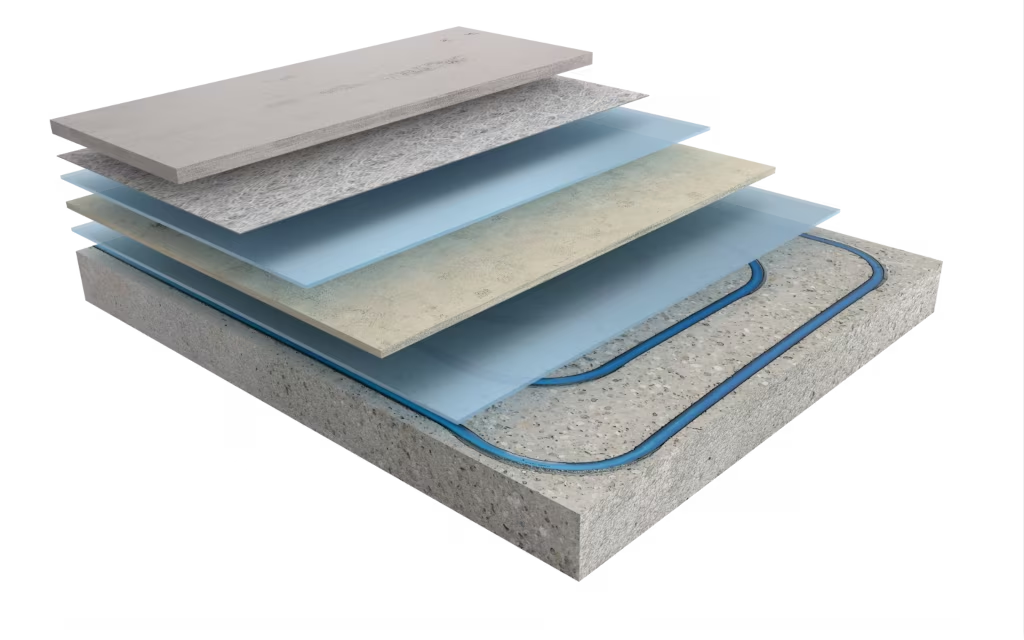
- Smoothing compound
- UZIN NC 196
- Renovation fleece
- UZIN RR 201
- Primer
- UZIN PE 360 PLUS
- Repair mortar
- UZIN NC 182
- Primer
- UZIN PE 360 PLUS
- Substrate with underfloor heating
Product information
UZIN NC 196 Fibre-Reinforced Smoothing Compound
- Fibre reinforced
- Thickness range from 3 to 40 mm
- Excellent flow properties and pumpable
- Low stress
- Excellent…
UZIN RR 201 Renovation Fleece
- heavy reinforcing
- covers cracks
- increases the stability of the smoothing compound
- absorbs vibrations and elongations and…
UZIN PE 360 PLUS Ready Mixed Primer
- ready mixed
- very economical
- rapid drying
- reduces the absorbency of the substrate
-
tolerant…
UZIN NC 182 Re-workable Low Slump Repair Mortar
- ready to accept floor coverings after 60 minutes*
- re-mixable, longer…
UZIN PE 360 PLUS Ready Mixed Primer
- ready mixed
- very economical
- rapid drying
- reduces the absorbency of the substrate
-
tolerant…
Precision groove cutting within screed boards
Alternatively, if no screed is present, for example, UFC is required over wooden floorboards, then pre-fabricated screed boards can be installed, and the channels can be grooved into the panels. It is important to note that JK floor heating has only tested the channel grinding with Fermacell® boards and no other pre-fabricated boards should be used. The underfloor heating pipes are then implanted within the panels. Different types of floor coverings can then be installed over the Fermacell® boards using products from UZIN UTZ UK, which have been tested and guaranteed to be compatible.
The brand JK fermafloor derived from the collaboration between the three companies. The benefits of using this system are minimal floor elevation, thermal improvement and acoustic reduction potential, yet the system is cost-effective, sustainable and very efficient. For more information and benefits about these unique systems click here.

Installing floors over underfloor heating
It is best to check with the floor covering manufacturer for their recommendations on installing over underfloor heating systems, but the following is a guideline for the different types of floor coverings. There are also some principles which apply to all flooring.
The underfloor heating must be fully commissioned and tested as described above. In all instances, the screed should be dry before installing the floor covering. When installing wood floors, the moisture reading must be less than 65 % RH (Relative Humidity), and for all other types of flooring, the reading must be below 75% RH. UZIN provide a range of damp proof membranes which would allow floors to be installed if the reading are above these levels (click here for more information). Please also note that moisture protection is normally only possible at a lower RH threshold when underfloor heating is present.
A room temperature between 13 ºC to 18 ºC should be sustained 24 hours prior to installing the floor as well as 24 hours after the installation. During the fitting, the surrounding temperature should be at least 18 ºC, and the floor temperature must not drop below 15 ºC.
Installing ceramic TILES or stone TILES over underfloor heating
The underfloor heating should be switched off and the tiles must be installed with flexible adhesives and grouts to compensate for any thermal movement. Once the tiles and grout have been installed, the underfloor heating should not be switched back on for at least 5 days. After this time, the heating can be switched on and temperature slowly increased 5°C a day until the desired temperature is reached. It is also important to ensure that the surface temperature throughout the installation does not exceed 27°C.
Installing carpets over underfloor heating
The underfloor heating should be switched off 2 days before the carpets are installed. Once installed, the heating should not be put back on for at least 2 days, and peak temperature should be avoided for another 7 days. It is also important to ensure that the surface temperature throughout the installation does not exceed 27°C.
Installing vinyl FLOORS over underfloor heating
The underfloor heating should be switched off 2 days prior to the installation of any resilient floor coverings, such as vinyl or linoleum. Once installed, the heating should not be put back on for at least 2 days, and peak temperature should be avoided for another 7 days. It is also important to ensure that the surface temperature throughout the installation does not exceed 27°C.
Installing luxury vinyl tiles over underfloor heating
The underfloor heating should be switched off 2 days prior to the installation of the LVT. Once installed, the heating should not be put back on for at least 2 days, and peak temperature should be avoided for another 7 days. It is also important to ensure that the surface temperature throughout the installation does not exceed 27°C.
Installing wood FLOORS over underfloor heating
The underfloor heating should be turned off for a minimum of 4 days before the wood floor is installed. The humidity and temperature within the area should also be maintained, and it is also important to ensure that the surface temperature throughout the installation does not exceed 27°C. After the wood has been installed, do not switch the underfloor heating back on for at least 3 days. When turning back on, set 1°C above the surrounding temperature and each day increase by 1°C until the required temperature is achieved. It is also important to note that each variety of wood has a different thermal resistance and thermal conductivity. The thickness of the wood also influences the heat transfer.
Installing resin FLOORS over underfloor heating
The heating should be switched off before the resin is installed. After the resin has been installed, the underfloor heating should not be turned back on until the resin has chemically cured, normally within 7 days. After this time, the heating can be switched on, and the temperature can be slowly increased by approximately 5°C a day until the desired temperature is reached. It is also important to ensure that the surface temperature throughout the installation does not exceed 27°C.
Suitable Underfloor Heating Products
UZIN PE 360 PLUS Ready Mixed Primer
- ready mixed
- very economical
- rapid drying
- reduces the absorbency of the substrate
-
tolerant…
UZIN NC 196 Fibre-Reinforced Smoothing Compound
- Fibre reinforced
- Thickness range from 3 to 40 mm
- Excellent flow properties and pumpable
- Low stress
- Excellent…
UZIN NC 770 Industrial Top
- Excellent abrasion resistance
- Good flow characteristics and pumpable
- Low stress
- High compressive strength and…
UZIN PE 630 2-Component Trowel-Applied Primer
- Fills, seals and smoothes in one application
- Sets hydraulically
- For application thickness up to 1 mm
- Flexible and ductile when set
- Low…
UZIN RR 201 Renovation Fleece
- heavy reinforcing
- covers cracks
- increases the stability of the smoothing compound
- absorbs vibrations and elongations and…
UZIN PE 260 Multipurpose Primer
- Highly concentrated
- Film-forming
- Ideal bonding agent on dense surfaces
- Great barrier
UZIN NC 570 Quick Drying FusionTec Smoothing Compound
- Quick drying, allowing floors to be installed after 8 hours
- Long working time, ideal for pump…
FAQ: Floor Covering Installation Over Underfloor Heating
How long should I wait before commissioning underfloor heating after screed installation?
For cementitious screeds, heating should not be commissioned for at least 21 days. For anhydrite screeds, wait at least 7 days. Standard sand/cement screeds dry at about 1 mm per day (up to 50 mm) and must not be force-dried, as this can cause cracking or curling. Once successfully commissioned, UZIN has a range of products for installing floors over screeds containing underfloor heating.
What is the correct procedure for commissioning the underfloor heating?
Always follow the UFH manufacturer’s guidelines first. Typically, once the screed is dry:
- Start at a low flow temperature (~25°C)
- Increase by about 5°C per day
- Go up to a maximum of 50°C and maintain for 3 days
- Switch the heating off and let it cool, but not below 15°C, before installing tiles or floor coverings with the recommended UZIN primers, smoothing compounds and adhesives.
This procedure helps protect both the screed and the UZIN installation system.
Can underfloor heating be added in renovation projects with existing screeds?
Yes. Both electric and water-based UFH systems can be installed retrospectively. They are usually installed as heating mats or boards (with wires or pipes) over an insulation layer. Depending on the final floor covering, a self-smoothing compound/screed, or tile adhesive is then applied on top before installation of the floor covering. UZIN offers compatible primers, smoothing compounds and flooring adhesives designed for these kinds of renovation build-ups over underfloor heating.
Why are movement joints important with underfloor heating?
Movement joints in the screed (e.g. at stairways or structural breaks) must be carried through to the floor covering. UFH causes thermal expansion and contraction; failing to respect these joints increases the risk of cracking, tenting, or debonding of the floor finish. To ensure the long-term performance of UZIN screeds, smoothing compounds and adhesive systems over underfloor heating.
Can I speed up screed drying by turning the underfloor heating on early?
No. Cementitious screeds should not be forced dried. Turning the heating on too early can cause cracks and curling in the screed, which can compromise the UZIN smoothing compound and floor covering installed on top. Follow the UZIN-recommended waiting times and commissioning procedure, alongside the UFH manufacturer’s instructions, to protect both the screed and the finished floor.

Need free advice and support? Contact Us
Please get in touch with us for free advice and support or to arrange a site visit.